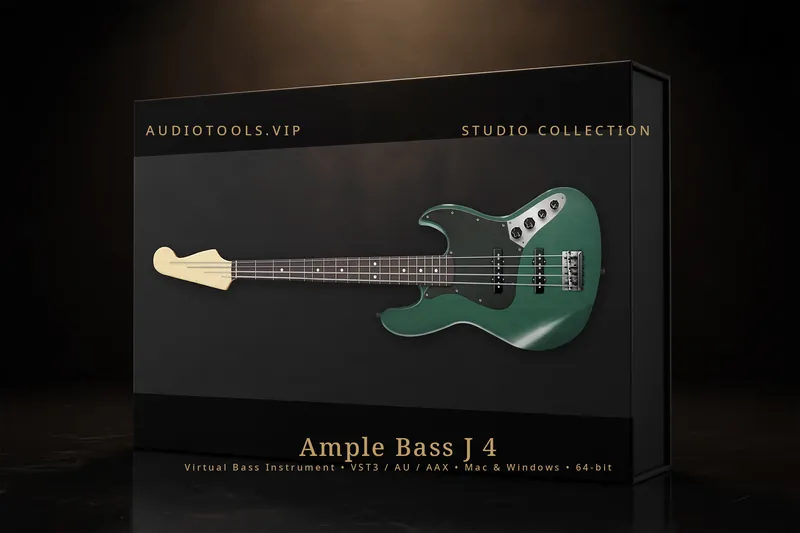
Product details
## Ample Bass J 4: 3.71 GB of Jazz Bass, sampled without shortcuts
Tone starts at the source, and Ample Bass J 4 starts with one of the finest Jazz Basses ever built — a John English Masterbuilt Fender Jazz Bass, captured across two complete libraries (Fingerstyle and Pick) in 24-bit detail. This is the v4 generation of Ample Sound’s bass engine, and its 3.71 GB of samples exist for one reason: so that no matter how hard you push a performance, the instrument never reveals itself as a sample.
Thirteen articulations cover the full vocabulary of the electric bass: sustain, palm mute, natural harmonic, hammer on and pull off, legato slide, slide in, slide out, slap, pop, tap, accentuated notes, repeat notes, and dead notes. Each was recorded to respond like the real thing — the muted thump of a palm-muted eighth-note groove, the glassy ping of a harmonic, the percussive crack of a slap — and the polyphonic legato engine plus the dedicated slide smoother make runs and glides connect seamlessly at any interval and speed.
### An amp room you can carry in your laptop
A great DI is only half a bass sound. Ample Bass J 4’s built-in AMP system models three classic bass heads — Vintage-15, Bass-500, and Bass-Pro — paired with four cabinets (1×15, 2×10, 4×10, 8×10), each captured with four microphone types: U87, C414, MD421, and SM57. That’s the kind of mic locker most home studios will never own, switchable in seconds. The FX section completes the chain with an 8-band EQ, compressor, delay, and convolution reverb, so the tone you monitor while writing is the tone that lands in the mix.
The difference between a good and a great virtual bass is what happens between the notes, and that’s where the v4 engine earns its keep. String and fretboard noise, release behavior, and the interaction of overlapping notes are all modeled, which is why exposed passages — a sparse verse, a bass feature, a jazz head — hold up under scrutiny where thinner libraries fall apart.
### Composition tools that respect how bass works
Riffer 4, the built-in MIDI editor for plucked strings, approaches bass writing from the instrument outward. Its string visualization system lays your MIDI across virtual strings, preventing the impossible — two notes fretted on one string — and choosing fingerings a session player would choose. You can work in piano roll or tab with instant switching between views, edit fingering, articulation, legato, and expression without touching keyswitches, and shape dynamics across multiple color-coded MIDI CC and velocity lanes, with one-click curve presets for common moves. A library of hundreds of bass riffs ships with it, and Tab Reader 4 imports Guitar Pro files from GP3 to Guitar Pro 8 — full bass tracks, fingering and articulations preserved.
### Specs that stay out of your way
Ample Bass J 4 runs as VST2, VST3, AU, and AAX (64-bit) with a standalone host included, on macOS 10.15 or newer and Windows 7 through 11 (64-bit). Plan on an Intel Core i5, AMD Ryzen 5, or Apple Silicon M1 or better, and just over 10 GB of free disk on an internal drive or a fast external SSD. Drop tuning down to B0 is supported for extended-range writing.
From Motown thump to modern metal grind, the Jazz Bass is the most versatile electric bass ever made — and this is the most playable version of it you can load in a DAW.
Every customer receives their own individual license key. Your Mac and Windows download links arrive by email instantly after checkout.



There are no reviews yet.