Product details
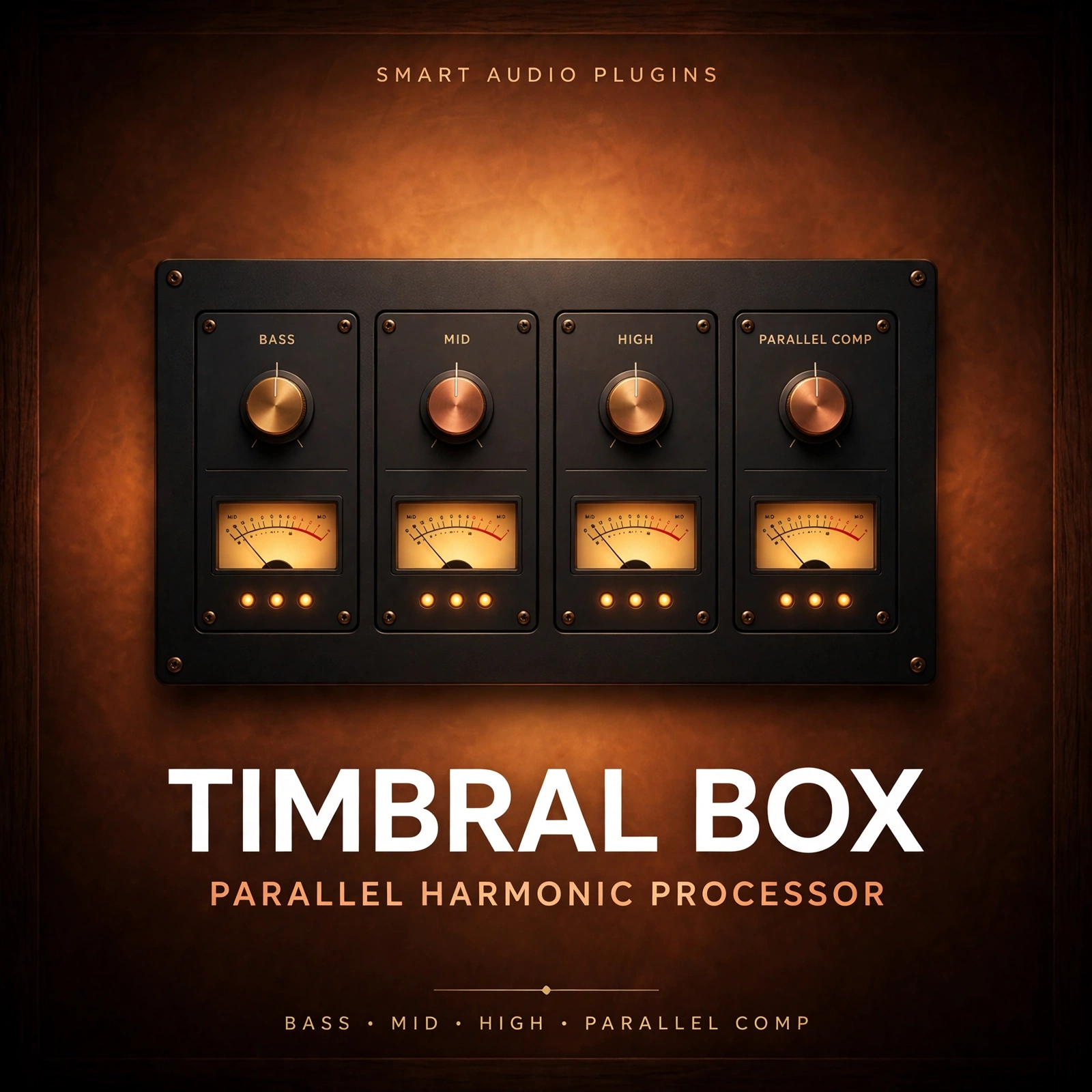
Download Smart Audio Plugins Timbral Box for Mac and Windows and add the one thing most mixes are missing: presence that does not cost punch. Timbral Box is a parallel harmonic processor for mixing and mastering. It never processes your dry signal at all.
Instead, four parallel layers — Bass, Mid, High and Parallel Comp — generate harmonics and add them alongside the original, raising RMS and LUFS through saturation with a tape-style character. The mix gets louder, closer and denser. The source stays exactly where it was.
That distinction is everything. Serial EQ and compression always trade something away: presence for naturalness, density for groove. Timbral Box, made in Italy by Smart Audio Plugins, sidesteps the trade entirely. Because the added energy sits next to the sound rather than on top of it, you can push the processing much further than a serial chain would survive — on vocals, drums, loops, buses and full mixes alike.
What you get in the download
One plug-in, four modules, one top panel. The Bass Processor works at 34, 55, 89 or 144 Hz with Bass Shape, Phase and Sat Mode controls. The Mid Processor adds Blend, Mid Shape, Mid Focus, Mid Frequency and 3D depth.
The High Processor adds Hi Shape, Hi Sparkle, Sat Mode and Phase. The Parallel Comp section adds Movement, Release and Full Mix / Instruments modes. The top panel adds Input with metering, bypass, Autogain with Analyze, Gain Link, a transformer saturation stage and Output, with a gain-reduction meter for the compressor.
Two saturation models, A and B, run through every processor. Model A is the lighter, clipping-oriented model; Model B combines clipping and saturation for denser, more compact harmonics that respond dynamically to the Shape controls. The output sums through a transformer stage inspired by the two transformers of the EMT 156, a 1970s compressor — the stage the maker considers worth the plug-in on its own.
Bass Shape: the control to learn first
If you learn one control, make it Bass Shape. Counterclockwise, the saturation curve opens the bass up: transients stay free, harmonics resonate longer, and the low end gains depth and length. Clockwise, the same control tightens the bass into a more solid, compact shape.
The Frequency selector then parks the processing on 34, 55, 89 or 144 Hz — Fibonacci frequencies chosen by ear that land where low-end energy naturally lives. Phase can be Natural for individual instruments or Linear for buses and masters, where linear is always recommended.
The same Shape logic runs through the Mid and High sections. Mid Shape compresses or lengthens the midrange; Hi Shape does the same work at the top. Combined with Blend in the Mid section — which at 0% with Sat Mode A turns the processor into a pure parallel equaliser — and 3D depth that adds dimension without touching phase, the Shape controls are where the sound design happens.
Parallel Comp and the two modes
The Parallel Comp section is not a conventional compressor. Movement controls the threshold and the curve together; Release shapes the musical movement that results. The section enhances perceived quality while keeping transients intact, and with Mode A and Movement it becomes a colouriser for loops and drums — on a drum bus it creates colourful, dynamic movement that no static effect can match.
Choose the mode for the job. Full Mix is the mode for buses and complete mixes. Instruments mode is for sound design and tone shaping on single instruments: a cross between a multiband compressor and an OTT, a compander shaped by the Movement knob. It can make elements of a single instrument resonate and vibrate beautifully — and it can damage a full mix, so keep it on instruments.
Levels you can trust: Autogain, Gain Link and VU calibration
Timbral Box is calibrated with VU zero at −12 dBFS, and the recommended working level is around −18 dBFS. Autogain with Analyze matches input and output levels so that you compare processing, not loudness: analyse the current state, change parameters, and re-analyse to update the compensation.
Gain Link holds the proportional relationship between input and output gain, so driving the input harder retunes the whole chain in proportion — a subtle fine-tuning control once a setting sounds right. With level-matched comparisons built in, every decision you make with Timbral Box is a decision you can trust.
System requirements: Timbral Box download for Mac and Windows
This download covers Mac and Windows. Timbral Box runs as a 64-bit plug-in in VST3, AU and AAX formats on macOS 10.15 or higher (Intel and Apple Silicon native) and Windows 10. It requires 4 GB of RAM minimum (16 GB recommended) and 200 MB of free space on the system drive.
Supported hosts include Ableton Live 11+, Bitwig 4+, Cubase 13+, Digital Performer 11+, FL Studio 23+, GarageBand 10+ and Logic Pro 10+ (AU), Pro Tools 12+ (AAX), Studio One 5+, Reaper 6+ and Cakewalk by BandLab (PC, VST3). A fully functional 14-day trial is available from the official Smart Audio Plugins page with no credit card required, and the official page carries level-matched dry and processed examples on drums, loops, acoustic guitar, piano, vocals and full mixes.
Frequently asked questions about the Timbral Box download
Is this download for Mac and Windows? Yes. This listing covers both Mac and Windows with the same full feature set, in 64-bit VST3, AU and AAX formats.
Does Timbral Box alter my original audio? No. The dry signal passes through untouched; all processing happens in parallel layers added alongside it.
What is the difference between Model A and Model B saturation? Model A is lighter and clipping-oriented; Model B combines clipping and saturation for denser, more compact harmonics. Both are available in every processor.
Which phase mode should I use? Natural phase suits individual instruments. Linear phase is recommended whenever possible, and always on buses and the master.
Is there a trial version? Yes — a fully functional 14-day trial is available from the official product page, with no credit card required.
Download Smart Audio Plugins Timbral Box for Mac and Windows, €39.99 instead of €89.99: presence, weight and loudness, added in parallel, with the source untouched.
There are no reviews yet.